2026-09-05 · Alexander
Why Mice Show Up in Youngstown Basements Every October and How They Actually Get In
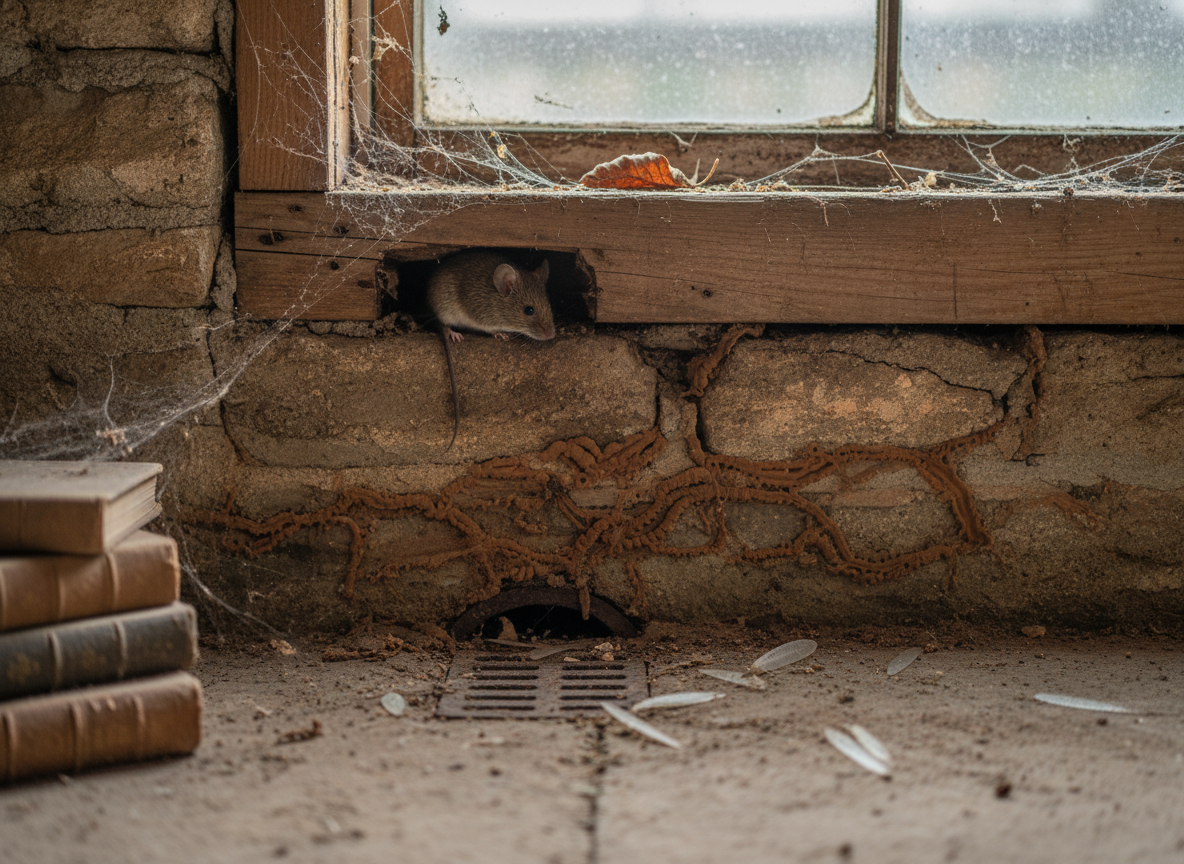
Mice show up in older basements every October because the first nights below about 40 degrees push house mice out of yards, vacant lots and detached garages toward heat and food, and homes built between 1900 and 1940 have dozens of pencil width gaps at the sill plate, sewer lateral and garage door that let them in.
Why October, every year
The house mouse does not hibernate. It lives outdoors through the summer in brush, mulch beds, wood piles, sheds and the tall grass of vacant lots, eating seeds and insects, and it breeds continuously as long as food and warmth hold up. When the first frost hits in early to mid October, the outdoor food supply collapses and the ground temperature drops, and the mice move toward the nearest heat source. In a neighborhood of 1920s frame houses with full basements, that heat source is the basement wall next to the furnace and water heater, which stays warm all winter and leaks that warmth through every gap in the foundation. Mice feel that warm air moving through a crack and follow it.
A female house mouse can produce a litter of 5 to 8 pups every 3 to 4 weeks, and the pups breed at about 6 weeks of age. Two mice that enter in October are a colony of 30 or more by January if nothing is done. That is why the first sign, a few droppings on the basement stairs or a bag of dog food chewed open in the garage, matters.
How they actually get in
A house mouse can pass through an opening about the width of a pencil, roughly a quarter inch. On older housing, those openings are everywhere, and they are almost always in the same 6 places.
- Sill plate gaps. The sill plate is the wood beam that sits on top of the foundation wall and carries the floor joists. On a stone or block foundation from the 1900s to 1940s, the top of the wall is uneven, the mortar has shrunk or fallen out, and the gap between wood and stone runs the length of the house. This is the most common entry and the least visible, because it is behind insulation or above eye level in the basement.
- Sewer lateral and utility penetrations. Where the sewer lateral, the water line, the gas line and the electrical service pass through the foundation wall, the original hole was cut oversize and packed with mortar that has long since crumbled. The sewer lateral opening is usually behind the furnace, in the dark, and never looked at.
- Garage doors. Detached and attached garages are the staging area. A garage door with a worn bottom seal and missing corner brushes lets mice into the garage, where they nest in stored boxes and eat pet food and birdseed, then move to the house through the shared wall or the door to the basement.
- Porch and crawl space openings. Wood porches with lattice or skirting, and additions built over a crawl space, have gaps at grade that mice walk through, then they climb the framing to the house.
- Dryer and exhaust vents. An unscreened dryer vent flap is a mouse door in winter, because warm air comes out of it.
- Coal chutes and old window wells. Many older basements have a bricked in coal chute or a basement window with a rotted frame. Both are common entries.
The house next door matters too. A vacant house or a demolished lot is a permanent mouse and rat source. Mice living there all summer are the ones that move into the occupied home in October, and they will do it again next year unless the occupied home is sealed.
How to tell mice from rats and from other things
Mouse droppings are dark, about a quarter inch long, pointed at both ends, and appear in numbers along walls, on the basement stairs, in the backs of cabinets and on top of the water heater. Norway rat droppings are larger, about three quarters of an inch, blunt at the ends, and fewer. Rats also leave burrows in the yard along foundations and under sheds, and greasy rub marks along the paths they use on joists and pipes. Mice leave much fainter rub marks and tiny footprints in dust.
Gnaw marks on the corners of cardboard boxes and on plastic bins in the garage are mouse work. Shredded paper, insulation or fabric packed into a corner of a drawer, a stove insulation panel or an engine compartment is a mouse nest. A musky smell in a closed room means the population is established.
Other things get mistaken for mice. Cockroach droppings are smaller and look like ground pepper. Bat droppings in an attic are similar in size to mouse droppings but crumble to dust and shine with insect parts. If you are not sure, put a few pieces of dry cat food on a piece of paper in the basement overnight and see what happens to it.
What to do about it
Trapping and sealing have to happen together, and sealing is the part that stops next October.
- Set snap traps on the runways. Mice travel along walls, not across open floor. Snap traps go perpendicular to the wall with the trigger against it, baited with a pea sized dab of peanut butter, in the places where droppings are. A dozen traps in a basement is not too many. Check them daily.
- Avoid poison indoors. A poisoned mouse dies inside a wall or ceiling and produces odor and flies for 2 to 3 weeks. Rodenticide belongs outside in a tamper resistant bait station along the foundation line or in a detached garage, placed by a licensed applicator according to the label.
- Seal with the right materials. Pack every gap with copper mesh, then seal over it with mortar or a quality sealant. Screw galvanized hardware cloth over larger openings such as crawl space vents and porch skirting. Replace the garage door bottom seal and corner brushes. Install a door sweep on the basement and side doors. Do not use expanding foam on its own. Mice chew through foam in days.
- Clean up correctly. Droppings are sprayed with a disinfectant and wiped up with paper towels, not swept dry. Sweeping puts dust into the air, and deer mice in outbuildings can carry hantavirus.
- Remove the food. Pet food and birdseed go into metal or heavy plastic bins with lids. Cardboard boxes in the garage go into bins too.
When it becomes a health problem
A few mice in a basement are a nuisance. A colony that has reached the kitchen is a health issue, because mice urinate constantly as they travel, contaminating counters, drawers and food packaging. Mice also carry fleas and mites into the house. Allergies to mouse urine protein are a documented trigger for asthma in children living in infested housing. A heavy, established infestation with a persistent smell, droppings in food storage, or mice seen in daylight is past the point of a few traps and needs a full trap and exclusion job.
FAQ
Why do I only get mice in the fall?
Because the first cold nights in October collapse the outdoor food supply and push mice toward the heat leaking through foundation gaps. The mice were living in your yard, garage or the vacant lot next door all summer. Sealing the gaps before October is what changes the pattern.
Will one mouse turn into many?
Yes. A single pregnant female entering in October produces a litter every 3 to 4 weeks, and the young breed at 6 weeks, so a colony of 30 by midwinter is typical if nothing is done.
Is foam enough to seal a mouse hole?
No. Mice chew through expanding foam within days. Copper mesh packed into the gap and sealed over with mortar or sealant, or hardware cloth screwed over larger openings, is what holds.
If the traps are not keeping up or the openings are more than you can reach, a full rodent control and exclusion visit handles both the mice and the gaps.