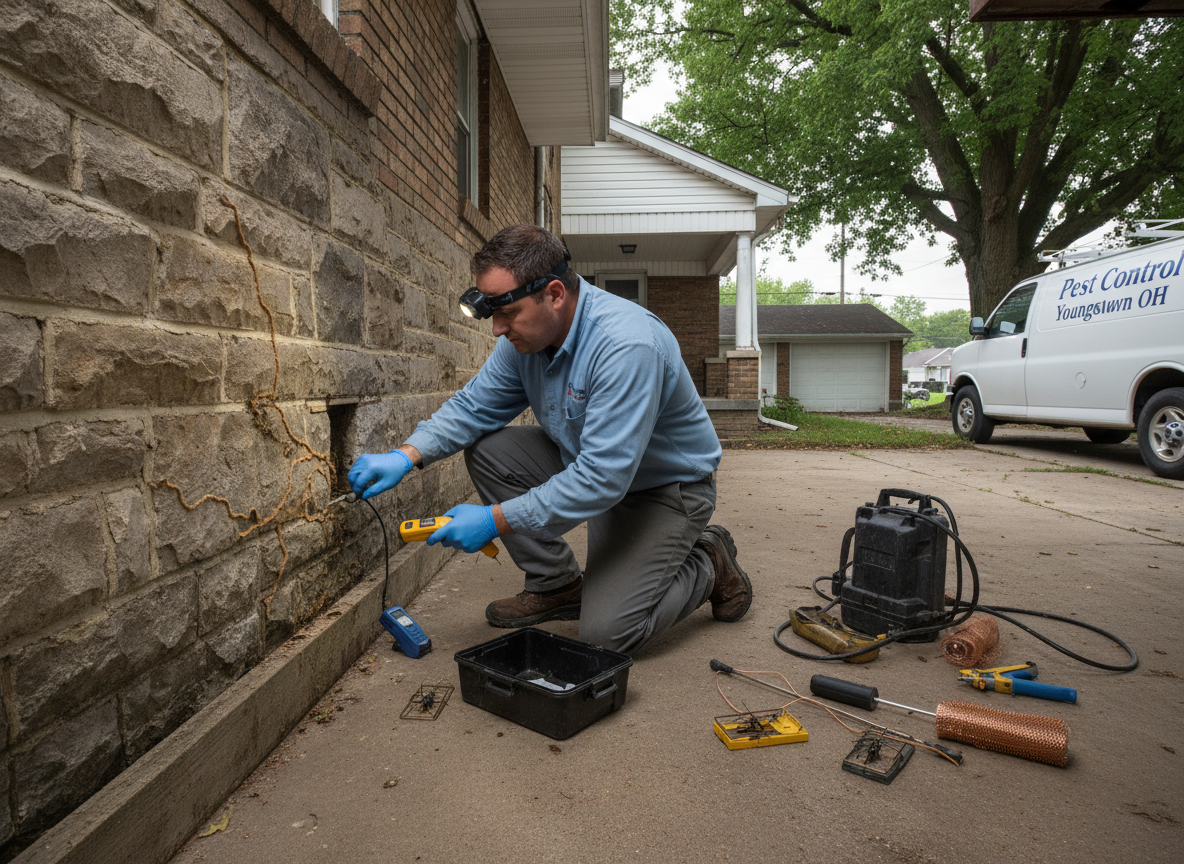
Rodent control from Pest Control Youngstown OH is a 3 part job: find how they are getting in, remove the ones already inside, and seal the openings. Alexander starts outside, walking the foundation with a flashlight held low to spot gaps where mortar has fallen out of a stone foundation, daylight under the garage door, the gap where the sewer lateral or gas line enters, and burrows along the foundation line or under the porch. Inside, the basement is checked for droppings along the sill plate, rub marks on joists, and gnawing at the base of the stairs, then the attic and kitchen. Snap traps go on the runways, tamper resistant bait stations go where traps cannot be managed, and the entry points get copper mesh, hardware cloth, sealant and door sweeps.
Mice and rats are the strongest driver of pest control calls in Youngstown. House mice move indoors in October when the first cold nights hit, and a 1920s home on a stone foundation has dozens of openings the width of a pencil that they use. Norway rats burrow along the Mahoning River, under porches and sheds, along the foundation lines of vacant houses and in demolished lots on the East Side and South Side, and they follow old sewer laterals into basements. A treated home next to an empty house will be reinfested within weeks unless the exclusion is done, because the vacant structure is a permanent source. In Boardman and Austintown, the calls are mice coming under attached garage doors and through gaps at the sump pump discharge and dryer vent.
Rodenticides are applied under an Ohio Department of Agriculture commercial applicator license, and the label requires that baits be placed inside tamper resistant stations wherever children, pets or wildlife could reach them, which is everywhere in a home. Baits are never scattered loose. Snap traps are preferred indoors because a trapped mouse is removed, while a poisoned mouse dies inside a wall or ceiling and creates an odor and a fly problem for 2 to 3 weeks. Bait stations are used along exterior foundation lines, in detached garages and around vacant property edges where the population is coming from. Droppings are cleaned with a disinfectant and not swept dry, because deer mice in outbuildings can carry hantavirus.
Spray only rodent control is not rodent control. The jobs that keep coming back are the ones where traps were set and nothing was sealed, or where the seal was done with expanding foam alone, which mice chew through in a week. Copper mesh packed into the gap and then sealed holds. A garage door with a torn bottom seal and worn corner brushes is the single most common mouse entry in the townships, and a new seal fixes it. In the city, the most common miss is the gap around the sewer lateral where it passes through the foundation wall in the basement, which is dark, behind the furnace and never looked at. Alexander finds and seals those on the first visit, and puts in writing any opening that needs a contractor, such as a rotted sill plate or a collapsed porch skirt.
Technician insight
Foam alone never holds. Mice chew through expanding foam in days, and most repeat rodent calls in Youngstown are homes where a previous company foamed the gaps and set traps. Copper mesh packed in first, then sealed over, is the difference between a fix and a subscription.
Mice in an East Side Home Next to a Vacant House
A typical job on the East Side: droppings along the basement sill plate every October, a vacant house next door, a stone foundation with missing mortar and a sewer lateral gap behind the furnace. Snap traps go on the basement runways, tamper resistant stations go along the shared property line and in the detached garage, 14 foundation openings get copper mesh and sealant, the garage door gets a new bottom seal, and the follow up at 10 days confirms no new activity. The stations stay on a checked schedule as long as the house next door is empty.
Rodent Control Services We Offer
✓Mouse Control and Trapping
Interior snap trap placement on runways, exterior bait stations, and follow up visits to remove catches and confirm activity has stopped.
✓Rat Control and Burrow Treatment
Norway rat trapping, exterior tamper resistant bait stations, burrow treatment along foundations, porches and sheds, and sealing of sewer lateral and foundation entries.
✓Rodent Exclusion and Entry Point Sealing
Sealing of foundation gaps, sill plate openings, utility penetrations and vents with copper mesh, hardware cloth and sealant, plus garage door seals.
✓Attic Rodent Inspection and Cleanup
Attic inspection for mice, droppings and nesting in insulation, trapping, and removal of contaminated insulation where needed.
✓Garage and Shed Rodent Control
Trapping and sealing for detached garages and sheds, which are the staging area for mice before they reach the house.
✓Vacant Property Perimeter Rodent Control
Exterior bait station lines and burrow treatment along the property line where a vacant house or lot next door is the source.
✓Rodent Droppings Cleanup and Sanitizing
Disinfection and removal of droppings and nesting material in basements, cabinets and garages after the population is removed.
✓Ongoing Rodent Monitoring
Scheduled bait station checks and trap monitoring for homes with recurring fall pressure or commercial accounts.
How it works
- 1
Entry Point Inspection
The exterior foundation, garage door, utility penetrations, porch and basement are inspected with a flashlight and every opening is marked.
- 2
Trapping and Station Placement
Snap traps go on interior runways, tamper resistant bait stations go along the exterior and in outbuildings, and the plan and price are put in writing.
- 3
Exclusion
Openings are sealed with copper mesh, hardware cloth and sealant, door sweeps and garage door seals are installed, and larger structural gaps are noted for a contractor.
- 4
Follow Up
A return visit in 7 to 14 days removes catches, checks stations, confirms activity has stopped and cleans up droppings.
Pricing
Rodent control pricing depends on whether it is mice or rats, the size and age of the home, how many entry points need sealing and how hard they are to reach, whether the attic is involved, and whether a vacant property next door means ongoing exterior stations are needed. A mouse job in a Boardman ranch with an attached garage that needs a door seal and 2 or 3 gaps sealed is at the low end. A 1920s city home on a stone foundation with rats burrowing from a vacant lot, attic activity and 15 or more openings is at the high end. Recurring monitoring is a lower per visit fee after the initial job.