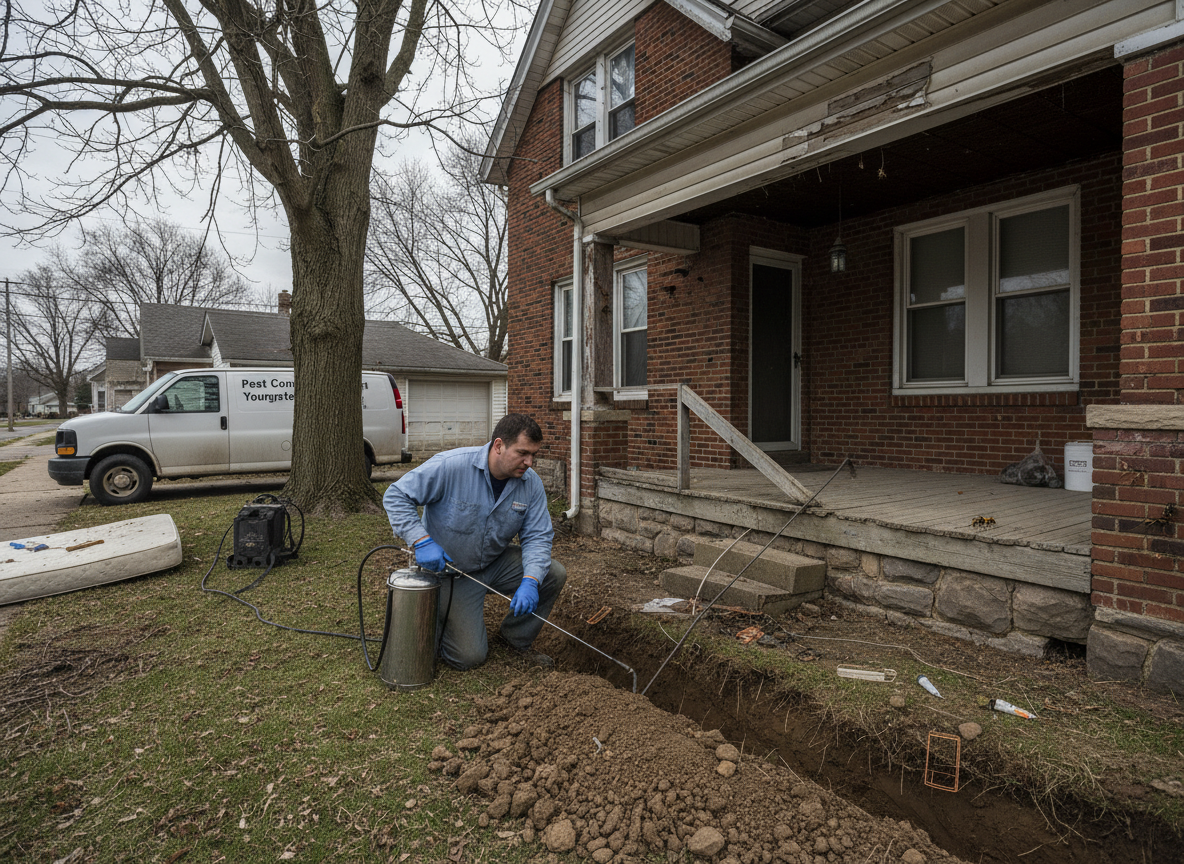
Termite treatment from Pest Control Youngstown OH begins with confirming the infestation and mapping the foundation. Alexander probes mud tubes on the basement walls, checks the sill plate, joist ends and porch framing with a screwdriver and moisture meter, and looks for swarmer wings on window sills and in spider webs. The treatment for eastern subterranean termites is a liquid termiticide, usually a non repellent product such as fipronil, applied in a trench dug against the exterior foundation and rodded into the soil, then the trench is backfilled. Where a porch, garage slab, basement floor or sidewalk meets the foundation, holes are drilled through the concrete every 12 inches and the termiticide is injected below. Bait station systems are an alternative or a supplement where trenching is not possible.
Youngstown termite jobs are shaped by the housing. A 1920s home has a stone or block foundation with an old sill plate close to grade, wood porch posts sitting on soil, and basement window frames rotted at the bottom, and every one of those is a termite entry. Additions built over crawl spaces have wood in contact with damp ground. Full basements mean the interior side of the foundation often has to be drilled and treated as well as the exterior, and old coal chutes and abandoned sewer laterals create voids the termiticide must reach. Swarms happen in April and May after a warm rain, and most calls come from swarmers on a basement window or wings on a sill. By the time swarmers appear, the colony has usually been feeding for a few years.
Termiticides are applied under an Ohio Department of Agriculture commercial applicator license and strictly by label, which sets the concentration, the gallons per linear foot of foundation, the depth of the trench and the distance from wells and water sources. Some termiticides are restricted use and cannot be bought or applied by a homeowner. The treated soil is not walked on until the trench is backfilled, and interior drill holes are patched the same day. Termite treatment does not require you to leave the house. A written warranty is issued with the treatment, and an annual inspection keeps it in force. If the home is being sold, the warranty transfers to the buyer.
The failures in termite work are gaps in the barrier. A trench that skips the 3 feet under the back porch because it was too hard to reach, a garage slab that was not drilled, or a sump pit discharge line that breaks the treated soil, and the colony finds the untreated path. Alexander treats the full perimeter, including the awkward spots, and documents the linear footage and gallons applied. Another common problem is carpenter ant damage or old, inactive termite damage treated as an active infestation. Old damage with dry, hollow galleries and no mud does not need a termite treatment, it needs a carpenter check and a moisture fix, and you are told which one you have.
Technician insight
The termite entry on most Youngstown homes is a wood porch post sitting on soil or a rotted basement window frame at grade, and the untreated gap in most failed jobs is the 3 feet under the back porch that nobody wanted to crawl into. Both get checked and treated on every job.
A West Side Sale With Swarmers on the Basement Window
A typical job starts with a homeowner finding shed wings on a basement window sill in May. The inspection finds a mud tube behind the furnace and a porch post on soil. The foundation is mapped at about 150 linear feet with a front porch slab, a side sidewalk and an attached garage slab. The open sections are trenched and rodded, the slabs are drilled at 12 inch spacing and injected, the holes are patched, and the written warranty goes into the file for the sale.
Termite Treatment Services We Offer
✓Liquid Termiticide Trench and Treat
A continuous trench and rod treatment around the exterior foundation with a non repellent termiticide, backfilled and documented by linear foot.
✓Foundation Drilling and Injection
Drilling through basement floors, porch slabs, garage slabs, sidewalks and patios at 12 inch spacing to inject termiticide where trenching is blocked.
✓Termite Bait Station System
Installation of in ground bait stations around the foundation, monitored and refilled on a schedule, used where liquid treatment is impractical or as ongoing protection.
✓Spot Termite Treatment
Localized treatment of a confirmed active area such as a porch post or a basement window frame, with foam or liquid, when a full barrier is not warranted.
✓Termite Damage Assessment
Probing and moisture reading of sills, joists, porch framing and window frames to determine whether damage is active, old or from carpenter ants, with a written summary.
✓Termite Warranty and Annual Inspection
An annual re inspection that keeps the treatment warranty in force and catches new activity early.
✓Pre Construction Termite Treatment
Soil treatment before a slab, addition or porch is poured, done to label rates and documented for the builder.
How it works
- 1
Confirmation and Mapping
The infestation is confirmed by mud tubes, live termites or swarmers, and the full foundation is mapped with slabs, porches and obstacles marked.
- 2
Written Treatment Plan
You get the treatment method, the linear footage, the areas to be drilled, the product, the price and the warranty terms in writing.
- 3
Treatment
The trench is dug and rodded, slabs and porches are drilled and injected, drill holes are patched, and any bait stations are installed and mapped.
- 4
Warranty and Follow Up
A written warranty is issued, a 30 to 60 day follow up checks for activity, and an annual inspection keeps the warranty active.
Pricing
Termite treatment is priced by the linear feet of foundation, how much of that perimeter is blocked by slabs, porches, sidewalks and garages that must be drilled, whether the basement interior also needs treatment, and whether a bait system is added. A small ranch on an open lot in Austintown is at the low end. A 2 story city home with a full basement, a wraparound porch, a garage slab against the house and a sidewalk on 2 sides is at the high end because of the drilling. The estimate is given after the foundation is mapped, never over the phone.