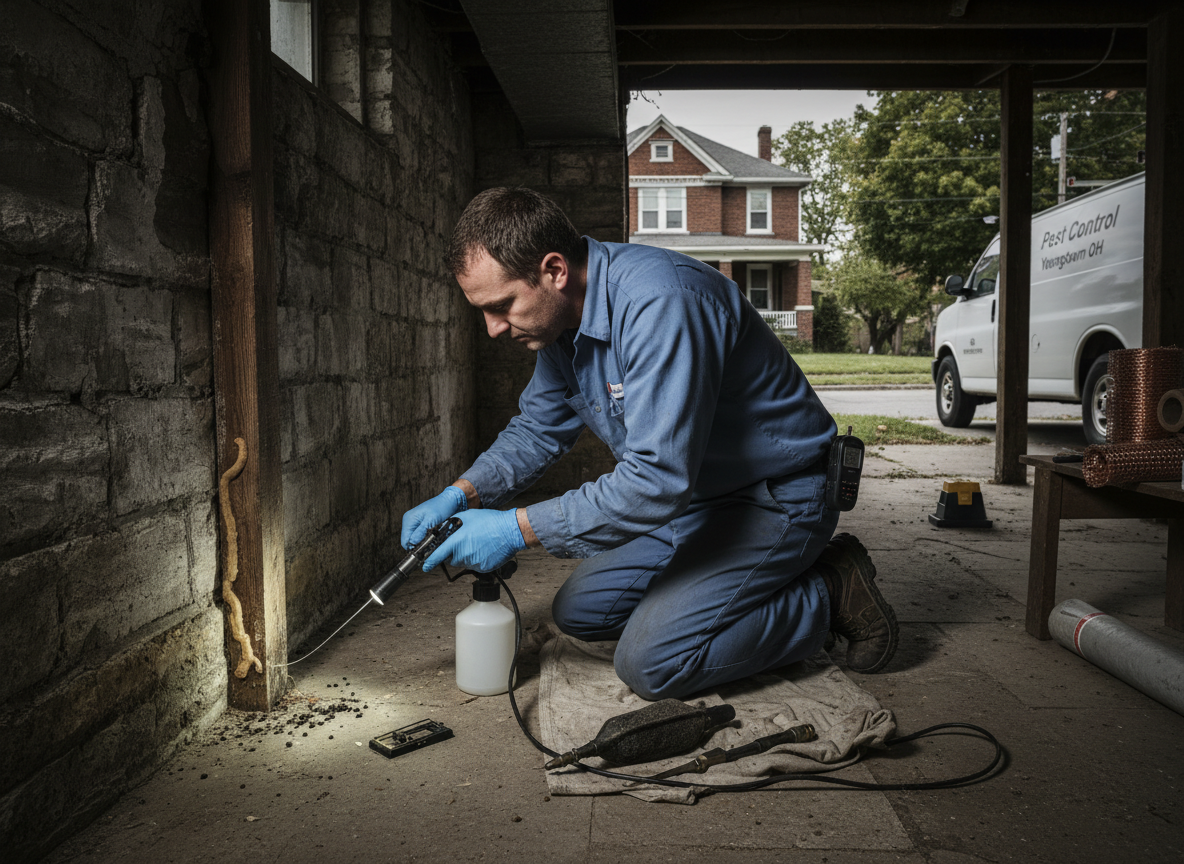
Ant control from Pest Control Youngstown OH begins with identifying which ant is in the house, because the treatment for carpenter ants is nothing like the treatment for the small ants on the kitchen counter. Carpenter ants are large and black or black and red, and they nest in wet or rotting wood: porch roofs, window frames, soffits, decks and the framing behind a leaking gutter. Alexander finds the nest by following foraging trails at dusk, tapping wood and listening, and reading moisture with a meter, then treats the nest directly with dust or foam in the void and a non repellent residual around the exterior. Odorous house ants and pavement ants are treated with gel and granular baits that workers carry to the colony, plus a perimeter barrier.
Youngstown's housing gives carpenter ants what they need. Old wood porches with roofs that have leaked for years, original wood window frames with rotted sills, soffits and fascia under gutters clogged with maple leaves, and decks built against the house are all wet wood. Homeowners often find carpenter ant frass, which looks like sawdust with insect parts in it, below a window or porch ceiling and assume termites. Odorous house ants are the small ants that show up on kitchen counters after rain, with nests under mulch, patio stones and in wall voids, and they spread by budding when sprayed. Pavement ants nest under sidewalks, driveways and the slab of an attached garage in Boardman and Austintown and come up through expansion joints.
Ant products are applied under an Ohio Department of Agriculture commercial applicator license and by label. Non repellent residuals such as fipronil are used on the exterior so foraging ants carry the product back to the colony instead of avoiding it. Baits are placed in stations or in cracks out of reach of children and pets and are left in place for workers to feed on for several days. Dusts and foams used in voids stay inside the wall. Interior liquid treatments are limited to cracks and crevices and are dry within a few hours. No product is called harmless. If the carpenter ant nest is in a wall that is also wet from a plumbing or roof leak, the leak has to be fixed or the wood stays attractive.
Ant jobs go wrong in 2 ways. The first is spraying odorous house ants with a repellent from a hardware store, which splits the colony into several satellite nests and turns a 1 nest problem into a 5 nest problem. The second is treating carpenter ants where they are seen instead of where they nest. A trail in the kitchen usually leads to a nest in a porch roof, a window frame or a tree within 100 feet, and a parent colony outdoors can feed satellite nests in the house for years. Alexander finds the nest, treats it, and tells you which wood is wet and why, because carpenter ants come back to wood that stays wet no matter what is applied.
Technician insight
The pile of sawdust under a Youngstown porch ceiling is carpenter ant frass 9 times out of 10, not termite damage, and the nest is in the wet wood above it. Look up, find the leaking gutter or the rotted soffit, and that is where the treatment goes.
Carpenter Ants Under a South Side Porch Roof
A typical carpenter ant job: large black ants on the kitchen counter in June and a pile of frass on the front porch floor. The trail is followed at dusk to a gap in the porch ceiling under a gutter clogged with maple leaves, the moisture meter reads wet, and the void is dusted with the nest treated directly. A non repellent goes around the foundation and the porch, the homeowner gets a written note that the gutter and the rotted fascia need fixing, and the check at 3 weeks finds the trail gone.
Ant Control Services We Offer
✓Carpenter Ant Nest Treatment
Locating the nest in porch roofs, window frames, soffits, decks or wall voids with moisture readings and sound, then treating the void with dust or foam and the exterior with a non repellent.
✓Odorous House Ant Baiting
Gel and granular bait placement along trails and at nest sites under mulch and patio stones, with a non repellent perimeter treatment to avoid budding.
✓Pavement Ant Treatment
Baiting and treatment of expansion joints, sidewalk edges, driveway cracks and garage slabs where pavement ants nest and enter.
✓Ant Perimeter Barrier Treatment
A non repellent residual around the foundation, porch, garage and door thresholds that stops foraging ants from entering.
✓Carpenter Ant Damage Assessment
Probing and moisture reading of suspect wood to determine whether damage is from carpenter ants, termites or rot, with a written summary for repairs or a home sale.
✓Ant Control for Kitchens and Restaurants
Baiting and crack and crevice treatment in commercial kitchens where sprays cannot be used near food.
✓Recurring Ant Prevention
Spring and summer visits on a quarterly plan timed for ant swarming and rain driven foraging.
How it works
- 1
Identification and Trail Tracking
The ant species is confirmed, trails are followed to the nest or entry point, and suspect wood is moisture tested.
- 2
Written Plan
You get the species, the nest location, the products, the moisture or structural fix needed and the price in writing.
- 3
Treatment
Nest voids are dusted or foamed, baits are placed on trails and at nest sites, and a non repellent perimeter treatment is applied.
- 4
Follow Up
A check at 2 to 3 weeks confirms the trail has stopped and baits are refreshed if workers are still active.
Pricing
Ant control pricing depends on the species, whether the nest is inside the structure, how accessible it is, and whether the home is on a recurring plan. A single odorous house ant trail treated with bait and a perimeter barrier is at the low end. A carpenter ant nest in a porch roof or a second floor window frame that needs void treatment and ladder work is higher, and a satellite nest situation with an outdoor parent colony takes more than one visit. Damage repairs are done by a contractor and are not part of the pest control price.